A Georgist class coalition
On the power analysis of Daniel Suhonen

NOTE: This post was initially written in Swedish, which can be read here. This version has been translated to English with AI, and edited by me.

I recently read Daniel Suhonen’s essay ”Vad hade Erlander gjort?” (Verbal, 2021. Literally transalted to “What Would Erlander Have Done?”), in which he briefly outlines a social democratic vision for Sweden. He draws parallels to Tage Erlander’s vision of Sweden and socialism during the 20th century, and it is a fairly accessible yet worthwhile piece. (Note: Tage Erlander was the Prime Minister of Sweden and leader of the Social Democratic Party from 1946 to 1969).
I agree with Suhonen on quite a few points, but what particularly caught my attention was his power analysis of what he calls the social democratic versus the moderate class coalition (i.e. the right-wing/conservative of the political spectrum in Sweden). According to Suhonen, the social democratic class coalition looks as follows:
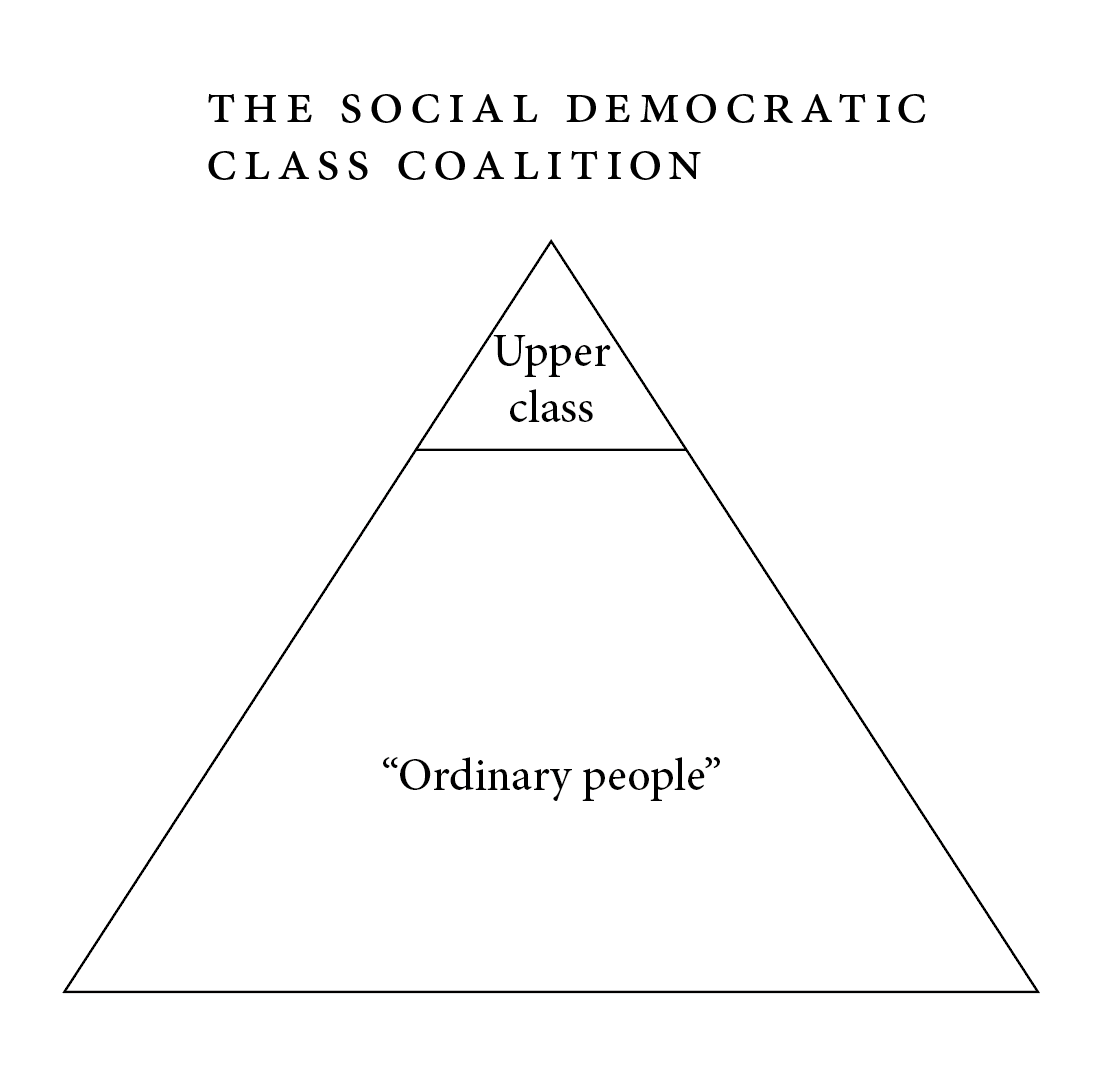
A small, exploitative upper class is set against the broad mass of “ordinary people.” He contrasts this with the moderate class coalition:
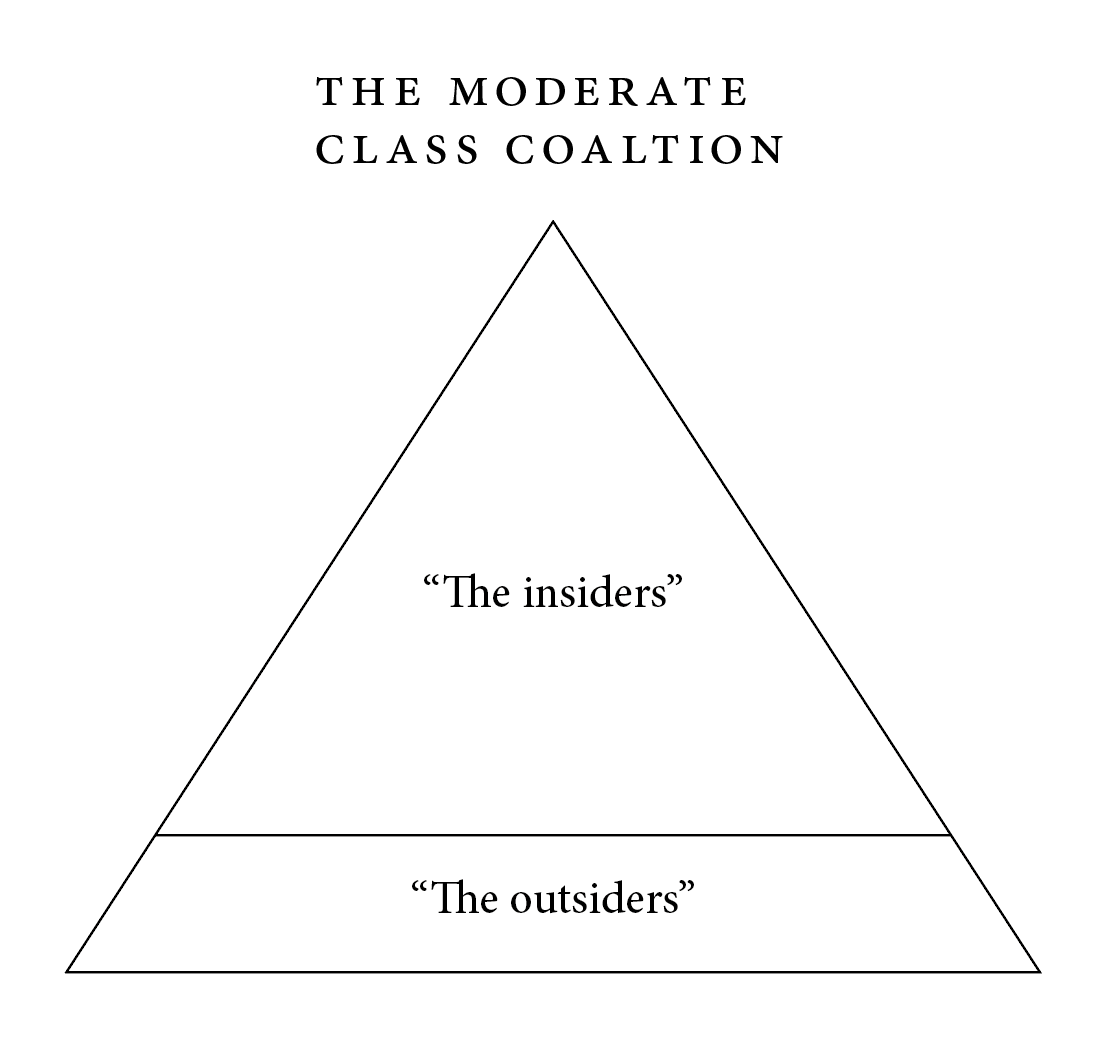
The broad “insider” group (with a dominant middle class) is set against the socio-political bottom stratum – the low-income outsider group.
Suhonen himself writes that he presents “…a triangle representing social democracy’s strategy of uniting the working class and the popular majority at the base against the apex, which corresponds to the small elite that, in economic terms, may benefit from right-wing policies. In the other pyramid, the right-wing pyramid, the upper class is united with the middle class and the well-behaved segments of the working class. A horizontal line separates the upper three quarters of the triangle from its base.” (Suhonen, p. 74, translated from Swedish)
In other words, a fairly classical socialist class analysis. However, both analyses overlook the problematic elements present within their respective majority clusters. The Moderates’ “insider” group and the Social Democrats’ popular majority inevitably contain segments that exploit the welfare state; conversely, both the outsider group and the upper class also contain subsets that contribute significantly to society in one way or another.
This kind of simplification thus misses a more fundamental dividing line. One way to address this is instead to construct a class coalition rooted in Georgism:
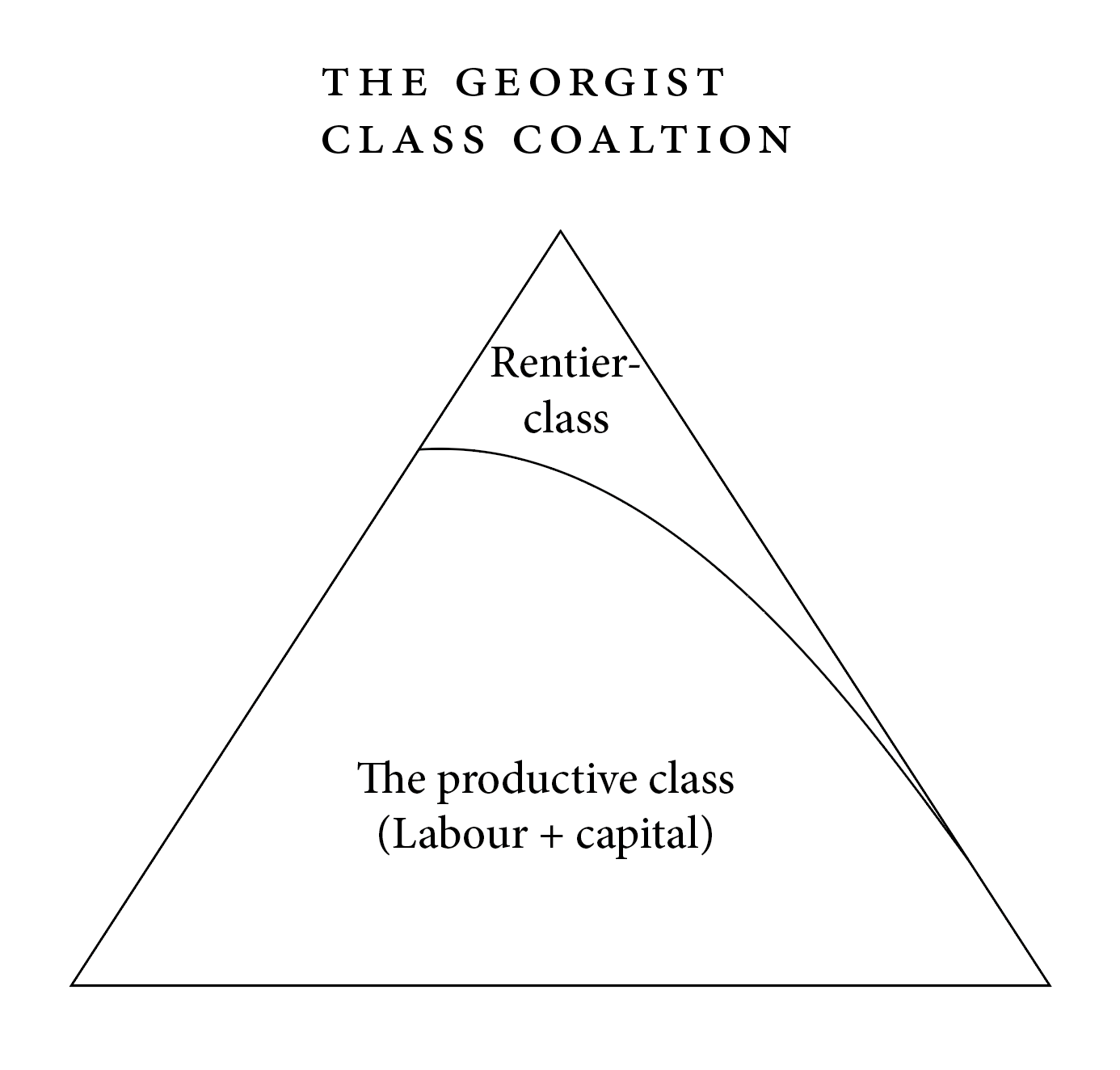
This, it seems to me, is the fundamental line of division in society – one which, although very simple, does not lose anything essential, as it focuses on how income is generated rather than on socioeconomic status.
What does this mean in practice? To explain this, we first need to define the term “economic rent”, which is the income that arises from owning and controlling a resource. It is not about producing something, but rather about owning something that others need. Let me illustrate:
Imagine a group of pioneers traveling to a habitable planet to colonize it. They settle on a narrow strip of land surrounded by water. Everyone chooses different places to settle: one builds a house on a hill overlooking the water, some build down by the shore, someone closer to the forest, and one person – let us call him Sven – builds his house right in the middle of the narrow passage, thereby blocking access across.
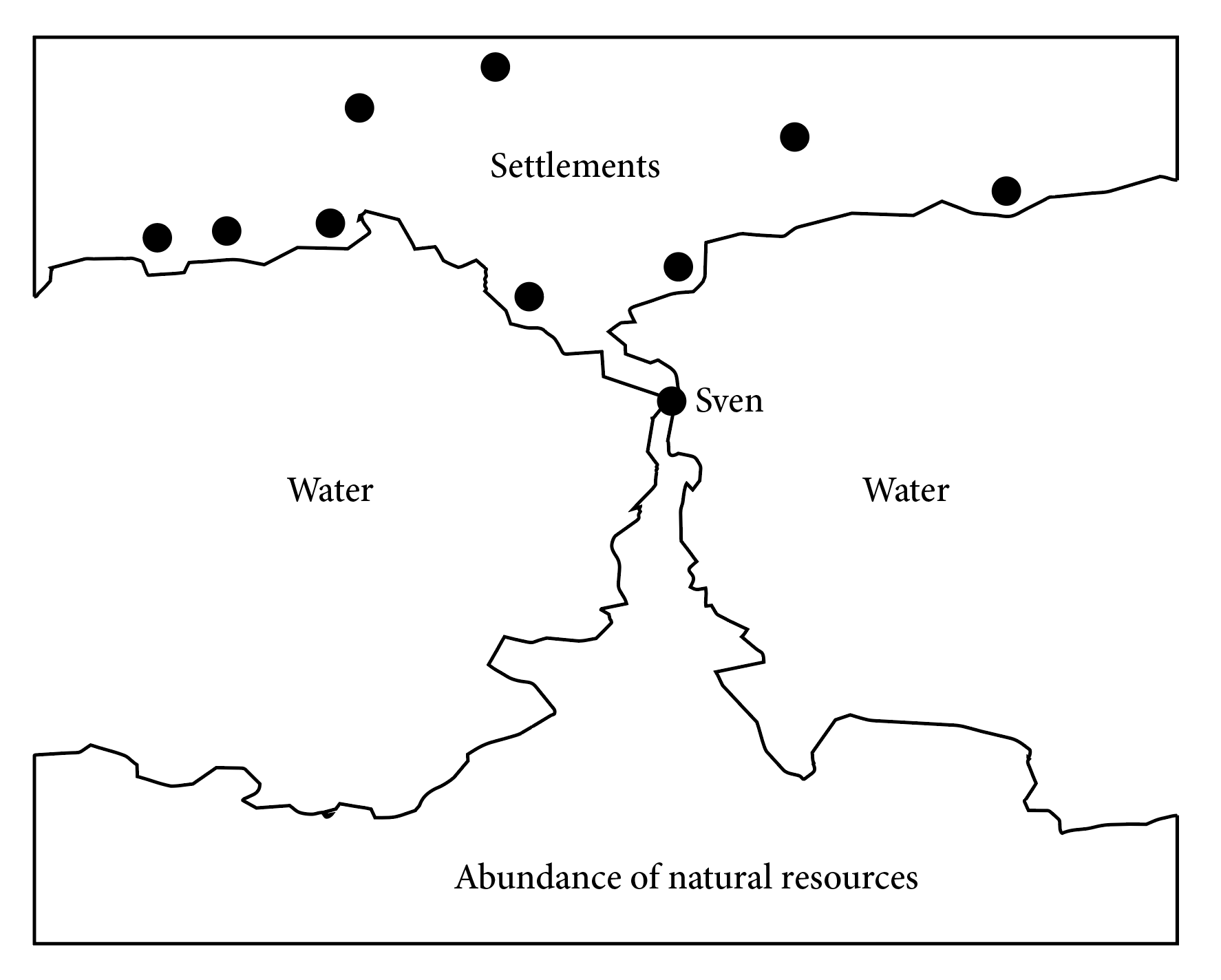
It soon turns out to be highly advantageous to cross to the other side, where there are valuable natural resources – food that does not exist on the settled side, game to hunt, and various minerals to extract. The grass is literally greener on the other side, in this example. Unfortunately, the surrounding waters are filled with dangerous creatures, so crossing by water is not an option. As a result, all settlers must now pay Sven to pass back and forth, since society has allowed him to appropriate that piece of land. Depending on the value of the resources and how difficult alternative routes are, the toll he charges can be very high.
But Sven has not produced anything himself or created any value; he merely earns money by owning a valuable natural resource – in this case, a piece of land that provides access to other resources. What Sven extracts is economic rent.
This is, of course, not merely hypothetical. In reality we see, for example, how land prices in Stockholm have risen sharply over a long period, generating substantial profits for property owners without necessarily corresponding to increased productive effort. Similar patterns exist in the control of other natural resources, as well as in certain digital platforms that function as “virtual land.” This phenomenon is therefore not limited to physical land.
The rentier class, then, is the class that lives primarily off economic rent rather than producing value. As the illustration above shows, it cuts across all social classes, though it is particularly concentrated in the upper strata. Nor is it a clear-cut division, since many people derive income from a mix of labor, capital, and economic rent – myself included, as I own the land on which my house stands.
The largest form of economic rent is land ownership. The simplest way to address this injustice and create a more equitable system of redistribution would be to socialize rent through the introduction of a land value tax – that is, to tax the value that arises collectively. Such a tax would not apply to what has been produced, such as buildings, but only to the land itself. It is fundamentally just, since it targets value created by society as a whole, making it reasonable that this value should also return to the collective, in the form of public welfare. Unlike other taxes, a land value tax is also non-distortionary, since the market cannot respond by producing less land; the supply of land is fixed.
Introducing such a tax would increase government revenue from the rentier class while allowing taxes on the productive class to be minimized, for instance through lower income taxes. We would thus stop taxing those who contribute to society – through work and production – and instead tax those who primarily extract income from society without corresponding production – through ownership of natural resources. According to the principle that you get less of what you tax, this would reduce rent-seeking behavior and increase productive activity.
As far as I know, there is unfortunately no evidence that Tage Erlander supported a land value tax during his time in power. At the time, the Social Democrats assessed that such a policy lacked popular support and was opposed, among others, by the agrarian class, and they therefore chose a different path. In recent years, however, a number of commentators from across the political spectrum in Sweden have once again begun to flirt with the idea.1 Even LO (The Swedish Trade Union Confederation) recently published a report in which a land value tax was viewed favorably.
I believe it is once again time for the Social Democrats to reconsider this idea with fresh eyes – and to seriously take a step toward a more just economy.
Perhaps Suhonen could lead the way here as well?
For example: “Den minst dåliga skatten (Arena Idé)”, Miljöpartiet kongresshandlingar 2019, “Inför ett system med markvärdesskatt (SvD)” och “Gröna studenter: Inför markvärdesskatt”
I liked the piece overall but this does not make sense and should be removed:
Similar patterns exist in the control of other natural resources, as well as in certain digital platforms that function as “virtual land.”
The whole argument for land taxes rests on the unique nature of physical land on the planet Earth. We can’t make more land on Earth, more or less. Virtual “land” is completely different. We can make endless amounts of it more and more cheaply every day. Another unique aspect of land, that you can’t destroy it, also doesn’t apply to “virtual land”.
I suspect this is an attempt to shoehorn a grievance against certain social media companies but it makes no sense and confuses the whole argument. The problems around new forms of digital media should not be forced into the discussion around land taxes.
I find fresh ideas stimulating. I will need to ponder this over so as to fully understand your article. Thank you for sharing such thought provocation.